v1.71.27 (2026-10-13)
Whole space graph view
We fully reworked graph view in Capacities.
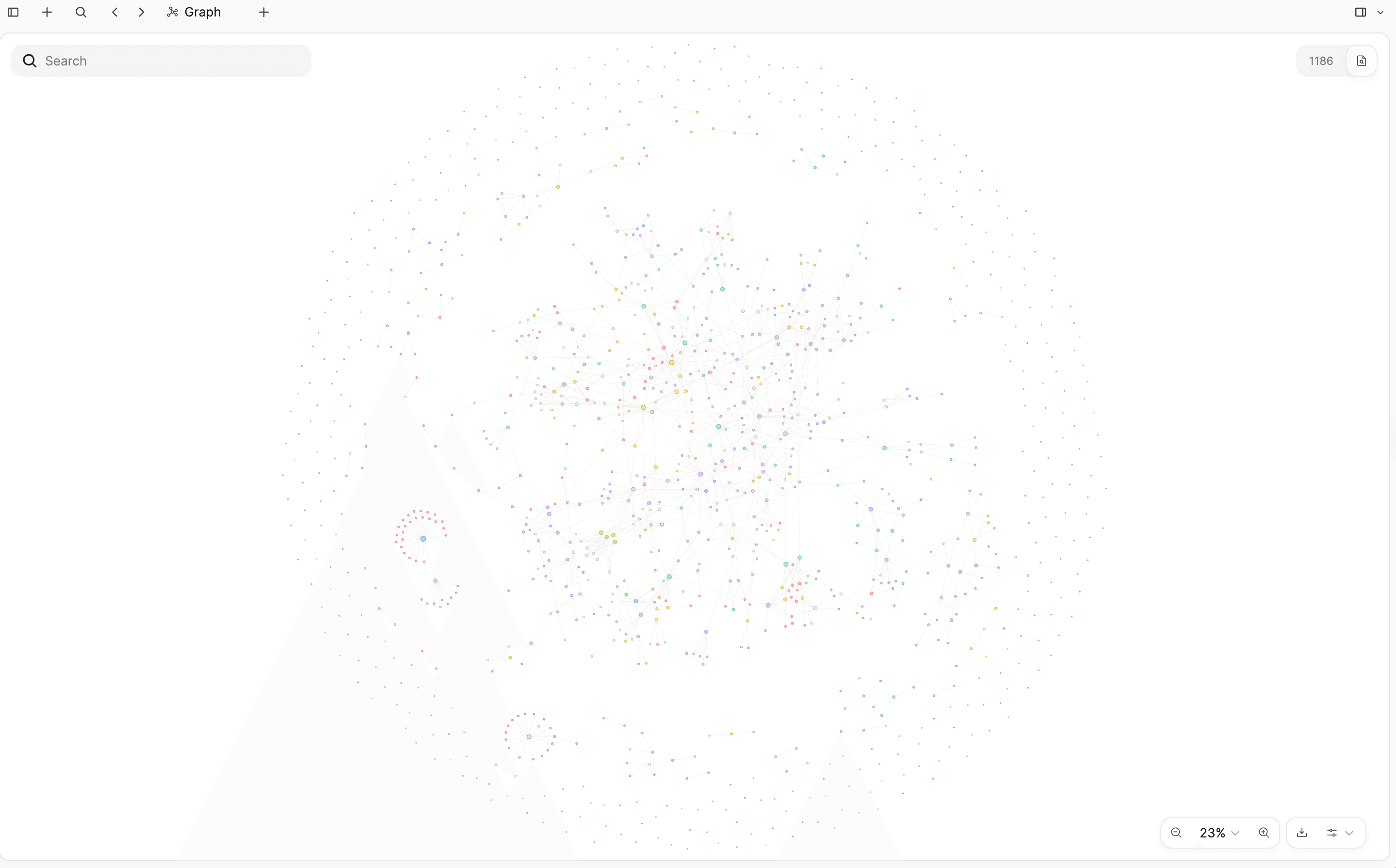
- Global graph: Navigate to "Graph" in the left sidebar to see the graph for all objects in your space.
- Semantic filtering: Type a search term and the graph narrows to the objects related to that topic. This is part of Capacities Pro.
- Navigate to a note in the graph: In the top right, you can search for a note and the graph will focus on that note.
- Graph view support for all views: You can also open a graph on a collection, a tag, a query, an object type dashboard, and in extended search. It draws the objects in that list and the links between them.
- Better performance: The graph is now faster to load and smoother on render, especially on large spaces.
✨ Improvements
Share
- On your phone, Save in space is on the share sheet. Links and files become objects in the space you pick. They are not added to today.
Files
- On a PDF, an audio file, or a file, AI comes before download.
Collections and queries
- You can rename a collection or a query from the title.
🐛 Fixes
Queries
- On your phone, a query shows New in the header. An empty query has it too.
Outline
- The outline marker follows the heading you are reading.
Reader
- A weblink keeps your reading place. A PDF keeps the page you were on.
Editor
- In a text property, Escape leaves the caret.
- The caret stays between two object chips.
Import
- When you import into a chosen object type, images in the text stay images.
PDFs
- Page width fits the page inside the viewer.
- On a computer, dropping a PDF onto an object embeds it.
Slides
- A resized image in a slide keeps its alignment.
Backlinks
- A full-path backlink shows only the column that holds the link.
Dates
- On a date, the hint for creating a calendar event sits above the field.
Menus
- On your phone, menus no longer draw a line between sections.
v1.71.24 (2026-10-09)
Editor performance
Long pages are now much more performant while you type, scroll, and move the pointer. This should make a big difference if you use large notes. The app should feel faster and more responsive across the board. Feedback on our feedback board is welcome!
Card view
Card views can be customized per view or query, separate from the object type. You can either use the default card from the object type settings or overwrite with a customized view. To customize a view, open the customize menu in the top right of the view.
✨ Improvements
Links
- You can select Inline as a default link option in the settings of an object type.
Navigation
- On the desktop app, the back and forward buttons on a mouse move through the current tab.
Queries
- You can group a date by hour. An all-day date shows the date only.
- A query with more than one object type can use a second group again.
- On a query page, collections are in the header menu, just before backlinks. On your phone, and in an embed, the collection chips stay under the title.
- A query embedded in a page no longer leaves a blank band under the results.
- The table customization menu moved to the view customization menu in the top right of the view.
Pages
- An empty page lists template names. Templates and Import open and close like the References tabs. Import still shows when the page has no templates.
Tasks
- On daily tasks, you can hide columns and change their order from the bar.
Widgets
- New Task and AI widgets can choose a space, the same way the daily note widget does. New Task only lists spaces that have tasks.
- On iPhone, the Search control can pin a space. Find or AI waits until that space is open.
Pinned
- You can unpin an object type from a pinned section. On your phone, pinned sections have the same add button as on a computer.
🐛 Fixes
Pages
- Typing a hyphen or an asterisk stays a bullet list when toggles use dots. Opening the page no longer turns those lists into toggles.
- On a computer, a right-click in an empty block still offers Paste.
- On Windows and Linux, spellcheck uses the language you chose. It no longer jumps back to English.
- Pressing Tab under a heading of the same size or larger turns that line into body text. Enter still starts another heading.
- Hovering a page header shows Customize again, including when the page has a cover.
- On an Encyclopedia page, dragging a block toward the edge scrolls the page.
Queries and views
- You can start a rectangle beside the view title.
- Dragging toward the edge keeps scrolling when the pointer moves onto the frame or the tab bar.
- A collapsed query on a page shows its full title.
- Shuffling a query opens the preview.
- An embedded table or kanban grows with the page.
- A gallery wider than the pane scrolls sideways.
- On your phone, a tag, query, or database stays a list. The layout menu is hidden.
- A progress bar uses the color you picked.
- When there is little room, the view controls stay on the header.
- On your phone, a query embedded in a page opens from the object menu. The title is no longer cut off.
- A selection rectangle stays hidden while you are already dragging a control on the page.
- Scrolling a kanban sideways keeps the nearby columns in place.
- On your phone, a page with many modes shows the later ones. They no longer get cut off.
Objects
- You can click an empty content property and type.
- Blocks you add stay when that object is also open on another device. Notes on a PDF highlight stay too.
- A two-way link also shows on the other object, even when that object was only a preview.
- A property set to hide when empty hides again after you leave it blank and reopen the object in the side panel.
Tags
- On a tag, search hides when the title would be crushed. Filter, sort, and group stay. Add stays a plus until there is room for the word.
- On your phone, long-press a tag, a collection, or a property chip to remove it. The close button is not shown.
Daily notes
- When reviewing is off, an embedded daily note hides Reviewed.
Navigation
- Go back from a space you cannot open returns to your home.
- Beside a tag, query, or database title, earlier pages open from a menu.
Media
- In Safari, audio on a shared page plays. Embeds and PDFs stay visible.
- Analyze image is on the page bar. On an image card it is a sparkle. The page still says Analyzed or Analyzing.
AI
- A chat that stalled shows Stop. You can continue from there.
- AI chat can edit a table embedded in a page, including on iPad, when that table was not fully open.
API
- An object created through the API with an empty content field is ready to edit.
Editor
- On iPhone, the first letters you type stay where you tapped.
- Opening a quick note keeps the caret, so the keyboard has somewhere to type.
- On iPhone, scrolling or editing no longer paints a black band across the top.
- On iPhone, the caret in search sits on the text.
Tasks
- On your phone, you keep a new task with Return or with the button.
- New tasks on the daily calendar use a plus icon.
- On your phone, the Status list fills the screen.
- A task shows its deadline even when that deadline is empty.
Calendar
- On your phone, the handle under the week strip is shorter.
Dates
- Typing October 20 sets the 20th of this year.
- The custom repeat menu uses the plural when you choose more than one.
Getting started
- On your phone, First steps fills the screen and scrolls clear of the buttons.
Shortcuts
- On iPhone, Capacities is listed again when a Shortcut shares with apps.
Mobile
- If the app reloads after it was in the background, the launch splash shows instead of a flash of the old page.
Windows
- On Windows, the window buttons no longer cover the top bar.
Web links
- Highlighting text on a web page no longer flashes a menu in the corner.
v1.71.19 (2026-10-02)
Queries
Capacities ProQueries can feel overwhelming, and they are a powerful way to work with knowledge, tasks, and projects. Because of this, we have reworked the query editor to make it easier to use while extending the functionality.
A new query starts with all your notes. You then decide what to filter by and how to show the results.
Here's what's new
- No scopes. A new query is all the notes in your space. Object types, tags, and search terms are filters, not a starting point you have to pick first.
- Tags and backlinks. Show all content that matches a tag, or a backlink. You can save a backlink view as a query. You can also exclude tags and backlinks.
- This object for backlinks. On an embedded query you can select This object for the backlink filter. You can embed a custom view of the backlinks in an object.
- This object for text properties. You can use that for a text property too. If Attendees is text, you can still embed a query of the meetings with that person on a person object.
- Create and edit on your phone or tablet. The query editor is available there, not only on a computer. On a narrow screen it fills the page. On a wider screen it sits beside the results.
Object type queries that also use tags show blocks as well as objects. A tag on a paragraph can bring that paragraph into the list. Objects and blocks is the default. If you only want the objects, open the query and set Show to Objects.
New filters
- Blocks content is empty / is not empty. Find notes where the page is empty or not empty. Useful for notes that are not written yet.
- Linked objects count. Notes that link to zero, one, or more objects.
- Linked objects includes / does not include. Notes that link to an object with or without a specific tag.
- Linked objects type. Notes that link to an object of a specific type.
- Backlinked objects count. Notes that are linked from zero, one, or more objects.
- Backlinked objects includes / does not include. Notes that are linked from an object with or without a specific tag.
- Backlinked objects type. Notes that are linked from an object of a specific type.
With these you can build:
- Orphaned notes. Notes that are not linked from or to any other note.
- Tasks by projects or people. Tasks whose context is a project, grouped by that project. These also show up as recommendations on the task dashboard.
Merging objects
You can merge one object into another of the same type. That includes two tags, two pages, or two objects of one type.
Open Merge into on the object you want to remove, then pick the one you want to keep. The one you keep holds its properties. Empty properties are filled from the other. Content from the other is added at the end. Links point at the one you keep. Lists such as tags pick up values the remaining object does not already have. A property with a single value stays as it is.
Calculations
With this update we are also launching calculation in a list, gallery, wall, table, kanban, or embed. This allows you to:
- Calculate the sum of a number property
- Calculate the earliest or latest date in a date property
- Calculate the number of checked checkboxes in a checkbox property
- And more...
A table shows it in the column footer. The other views show it with the objects at the top. When the view is grouped, each group shows its own result. You can add calculations in the customization menu of a query or data view in the top right.
The choices follow the property. A number can be a sum or an average. A date can show the earliest and the latest. A checkbox can show how many are checked. On a query, the choices follow the object types in that query.
Navigation 2.0
We reworked navigation based on your feedback.
- Tabs. Each tab keeps its own history, including after a restart. Phone, tablet, and computer keep their own.
- Views and scroll. The view, its filters, the calendar day, and your scroll position come back when you go back.
- Configure opening behavior per space and device. On every device you can choose the opening behavior for each space.
- Better delete behavior. When you delete an object, the app navigates to the previous page under all circumstances.
- Browser. The browser's back and forward buttons are discontinued. Use the arrows in the header.
Selecting and moving several objects in queries and data views
In a query or an object view, drag across the objects to draw a rectangle. Everything the rectangle covers is selected. You can start that drag in the empty space of the view, or in the empty space around a full-page view.
Drag one of the selected objects and the others come with it. Drop them on a group, such as a column on a board, and they all move into that group. Drop them on a tab to open them. Drop them on the space overview or the side panel to add them there.
The view scrolls while you draw the rectangle, and while you drag toward the edge. On a board it also scrolls sideways.
✨ Improvements
Settings
- Settings are grouped into Account, General, Space, and Integrations. Appearance and the AI Assistant sit in General. You can search settings, and a match opens that setting.
Home screen
- A New Task widget opens a new task in the app.
- An unpinned Daily Note widget opens the space you last used.
Import and export
- An empty page has one place to choose a file. On a computer you can also drop a file there.
- A task file imports as tasks. Linked Markdown reuses an object that already has the same type and title.
- Automated full export remembers how many copies to keep.
AI
- You can hide AI inside the app without turning it off. It stays available through MCP and AI chat connectors.
- The overall performance of the AI assistant within the app has been improved.
Search and objects
- When you search to pin, mention, or set a task context, a matching type can offer to create one.
- You can create object types on your phone. When a whole block is selected, picking an object type turns that block into an object.
Queries
- You can filter a date for dates that have an end. The assistant can use that filter when it builds a query.
🐛 Fixes
Queries and views
- A tag query that filters to people on this object keeps that filter.
- Saved queries show again on an object's overview and in the add menu.
- On your phone, columns further along a board show their cards.
Calendar and tasks
- The daily note outline stays on the note, to the left of the calendar. The sidebar lists objects whose date property falls on that day.
- An open task stays on the day it was dated. A long task title wraps inside a small card.
Pages and media
- On a computer, dropping a file on a page shows where it will land.
- Find in page counts each embedded object once.
- PDF highlights stay on the page, including in columns and on a scanned page, and stay visible on iPhone.
- Clicking an image or a PDF opens the preview, with notes hidden.
Apps and links
- On your phone, a link to a space or an object opens the app.
- On iPhone, the app stays signed in, and downloads finish.
- Opening Capacities in a second browser tab asks you to use it there.
API
- Updating an object through the API keeps two-way links in sync on the linked objects.
- Task webhooks can use Hookdeck.
v1.71.12 (2026-09-23)
✨ Improvements
Search
- Object types rank above notes that only share a prefix. Search for "Book" and the Book type sits above titles like Booking.
- An exact title ranks above a longer title that starts with the same words.
🐛 Fixes
Editor
- Long pages scroll correctly. Blocks further down load as you go, including profile and encyclopedia layouts.
- Pasting several lines into a single-line field keeps all the text. Line breaks become spaces. Pastes longer than 10,000 characters are cut with ...
Daily notes
- If reviewing is turned off, Reviewed no longer shows on small cards.
Cards
- Property icons sit in the center of the rail.
Audio
- On iPad, a recording stays saveable after a reload, a call, Siri, or dictation. The timer keeps running.
- On Mac, pasting a voice memo no longer creates two audio objects.
Android
- New-task widgets and Context stay on the space you opened. Back dismisses an empty draft.
Export
- Collection CSV export fills description and tags. Description is the description field, not the page body.
Calendar
- Table and kanban on a day scroll with the page again. The horizontal scrollbar stays on the visible pane in other table and kanban views.